Last updated: August 28, 2025
A crate/kennel can be a lifesaver for dog owners. They’re handy tools for keeping mischievous canines out of trouble, and for traveling.
But! Let’s get a few things straight:
Crates are not magic. They’re not a shortcut to a perfectly behaved dog. And they’re definitely not the only option.
I used to be way more enthusiastic about recommending crates to all dog owners. In the first version of this article, written back when I was a wee baby dog trainer, I said that crates were the “best invention to hit the dog world since the tennis ball.”
Lol okay bro, settle down.
My opinion is more nuanced these days.
You’ve probably heard the old saw, “dogs are den animals, so they naturally like crates!” Most of us dog trainers have parroted that line at some point. Myself included.
Now that I am older and wiser or whatever, I know the truth is more complicated than that. I’ll spare you the boring animal behavior science details. Right now, all you need to know is that dogs aren’t really den animals the way people usually mean it.
What this means for you:
- Dogs are not instinctively drawn to crates, so we have to put in the work to condition them. It’s a gradual process, not an afternoon project.
- If your dog really struggles with crating, there’s nothing wrong with him. You don’t have to force it; there are plenty of other ways to keep him out of trouble.
How crate training can make your life easier
If you have a new dog or plan on getting one, getting a crate is a solid first step.
In most cases, if properly conditioned, a dog will come to treat it as their bedroom. A safe retreat from the stress of life with those crazy two-legged members of their family. Lots of dogs seek out their crate when it’s time for a nap.
Crates are great for:
Behavior problem prevention and management. They give you a safe, reliable way to prevent your dog from practicing unwanted habits when you can’t supervise.
And if the behavior problem in question involves aggression towards the people or other pets in the house, reliable prevention is all the more critical.
House training support. The idea is that healthy dogs don’t like to soil the place they sleep. So when you can’t supervise, you can put the dog in the crate and be reasonably certain he won’t have an accident. But this one can be… iffy. More on this in a bit.
Puppy socialization outings. If you’re going to take your puppy to socialize at grandma’s house or a friend’s house, bring the crate so he can take breaks when he needs them. It’ll also help prevent the puppy from peeing on grandma’s carpets. If you want your puppy to be invited back to grandma’s house, that’s kind of important.
Car rides, travel, vet care, the groomer, dog sports events, etc. Most dogs will need to be crated eventually. So it’s worth crate training your dog at some point, whether you end up using them for at-home management or not.
But, you know, too much of a good thing…
People often rely on the crate too much. Dogs end up crated for 8+ hours per day while their families are at work and school. Imagine being stuck inside a box that was just big enough for you to stand up, turn around, and lie down in from 8:30 am to 5:30 pm. Now imagine doing this five days a week. You’d go crazy, too.
Crates were not designed to contain dogs for very long periods of time. Dogs who are over-crated can become destructive, hyperactive, anxious, or even develop bladder infections from having to hold it all day.
Crates and house training: the nuance
You’ve probably heard the classic logic:
“Dogs don’t like to pee where they sleep, so put them in a crate and they’ll learn to hold it.”
This is technically true. But let’s examine what that really means.
If the crate is preventing your puppy from having an accident, that’s because they’re choosing not to go even when they kind of need to. That means they’re uncomfortable. And while short stretches of that are sometimes unavoidable, we don’t want to rely on discomfort to teach our puppies anything. We want them to succeed because we’ve set them up well.
So yes, crates can be a (very!) helpful tool for house training. But don’t push your dog’s limits too far. Use crates as one part of a balanced strategy, not as the whole plan.
Crates aren’t the only option for puppy training, house training, or behavior management
Yes, all dogs need to trained/conditioned to be chill about their crate. But some dogs find crate confinement so frustrating, that conditioning takes a LOT more time and effort. That may not be practical for you. You might be better off using something like a playpen, or a small room (the bathroom or laundry room) with a baby gate across the doorway.
We’ve worked with new puppy parents who came to us after weeks of struggling with crate training. It had become such a negative experience that they were sick of it. Mildly traumatized, in one or two cases.
And we could have them start crate training over from the beginning, with baby steps and a better training plan.
But we usually don’t.
We just find some other management solution that isn’t so fraught with misery. We can always come back to crate training later, once the chaos of the puppy adjustment period is over.
So if you’re feeling overwhelmed trying to crate train a puppy who’s totally not having it: it’s okay. You have our blessing to skip it.
Crying in the club – uh, crate: the difference between crate training and “being alone” training
This is one of the most common mix-ups we see:
“My puppy must be struggling with crate training, because she cries every time I leave her in there.”
Sometimes, sure, that’s a crate issue. But more often, the real problem is that she’s struggling with being alone.
These are two separate training projects. Most puppies are gonna have a hard time being alone, because that’s a scary, unnatural experience for a baby dog.
Getting used to spending time alone is challenging all by itself.
And getting used to being locked in a tiny box is challenging all by itself.
When you put a puppy in a crate AND leave the room? Hoo boy! That’s a big ask for such a little critter.
In our program, we usually have our students split these two challenges apart and teach them separately before combining them. Starting with duration in the crate, where you sit right next to them (watching tv, reading, scrolling, etc) for longer and longer periods of time. And incorporating short periods of non-crated separation throughout the day.
What Not to Do
Crates are a powerful tool. With great power comes great responsibility.
Do not:
- Crate the dog without properly introducing it first. Being trapped in a cage without being acclimated to it first may traumatize your puppy. Like with all training, start easy and level up slowly.
- Rely on it too much. Too much crate time can lead to accidents, bladder infections, and boredom-related behavior problems. Not to mention the psychological ramifications of being stuck in a tiny box all day.
- Use it as punishment. The crate should never be a place of banishment. If you associate it with yelling or frustration, your dog will quickly learn to hate it.
Frequently Asked Crate Training Questions
How long can you crate your dog?
I’m gonna give you everyone’s least favorite answer:
It depends.
Aaand I’m gonna follow that up with this equally infuriating elaboration:
Only your dog can tell you how long is too long.
As you go through the list of Google search results, every other article you see will include guidelines and Rules of Thumb that sound very official, like “your puppy’s age in months plus one.”
But the truth is that these are just opinions that we Dog People have passed between ourselves so long we’ve forgotten they’re totally arbitrary and made up.
The actual answer is gonna be highly subjective and context-specific.
For example: “How long can a five-month-old puppy be crated?”
It depends! How long have you been crate training them? If you’ve been practicing with them for the last three months, they can stay in the crate a hell of a lot longer than if you just adopted this puppy yesterday.
And are we talking overnight, or during the day? Most dogs can be crated longer overnight, because they’ll be sleeping.
And how well have they adjusted to the crate? If they’re totally chill about it, they can be confined longer than an anxious puppy who struggles to relax in their crate.
“Dude just give me a straight answer before I hit the back button and read someone else’s article.”
Wow okay fine. I think I’ve made my point. I’ll show you the general guidelines we teach our students. As long as you understand that:
- These are extremely general. A starting point. Not Science™. Not ancient wisdom passed down from a mystical dog whisperer.
- You need to listen to what your dog tells you. Puppy has a pattern of soiling their crate after 30 minutes? Cool. Their limit is 25 minutes. Dog bounces off the walls and develops stress-related behaviors after being crated four hours a day? Cool. She probably needs to not be crated that long, then.
Here ya go, the extremely subjective unscientific guide to how long your dog can be crated without a break:
Medium/large breeds:
- 2 months old: 1-2 hours
- 3 months: 3–4 hours
- 4 months: 4–5 hours
- 5 months: 5–6 hours
- 6+ months: max 7–8 hours (and that’s really pushing it)
Toy/small breeds:
These pups have tiny bladders. Their limits are shorter – sometimes by half. If your ten-week-old chihuahua can only go 45 minutes without needing a break, that’s pretty typical.
Important notes:
Consider the maximum time limit to be the hardest level. During the first couple weeks of acclimating your dog to her crate, don’t crate ANY puppy more than two hours straight (except overnight) if you can avoid it.
These maximum time limits assume the puppy has been correctly house trained/crate trained up until that point. That five-month-old pup who’s been successfully conditioned for the last two months can be probably be crated for six hours sometimes. The five-month-old you adopted yesterday cannot.
6-8 hours is a REALLY long time to be crated. Not just for “holding it” reasons, but for sanity reasons. Sure, some dogs can snooze the entire day away in a crate with no ill effects, but many dogs will lose their minds. So I wouldn’t plan on doing that on a daily basis for the long-term.
What if you need to be away longer than your dog can comfortably be crated?
If you can’t get someone to babysit for you, try one of the crate alternatives here: Mischief Management
Should you use a crate if your dog has separation anxiety?
This answer may come as a surprise, but if we’re talkin’ bonafide, clinical separation anxiety, then no. These days, most leading separation anxiety specialists don’t use crates in their training plans. Being crated often makes the dog’s anxiety worse, not better.
Understandable. If I were having a panic attack, I wouldn’t want to be trapped in a tiny box, either.
What kind of crate should you get?
There are two main types: wire crates and plastic airline kennels. Both work fine. Our personal preference for medium-to-large breeds is wire. Wire crates are collapsible and lightweight. Large plastic kennels are a pain to move.
But for small breeds, plastic is good. Small plastic kennels have handles on the top, allowing for easy transport.
Avoid soft-sided cloth crates. Soft crates are portable but not secure.
What size?
Depends on why you need one.
For puppies and newly-adopted rescue dogs who aren’t fully potty trained:
In most cases, you’ll want one that’s just big enough for them to stand up in, turn around, and lie down/stretch out in comfortably. Any larger, and they could use one end as a bed and the other end as a bathroom. Which isn’t exactly what we’re going for.
Does that mean that you have to keep buying new crates as your pup gets bigger?
Nope. You can get one that, as best as you can tell, will fit her adult size. Crate manufacturers make separate panels that you can use to adjust the size of wire crates:
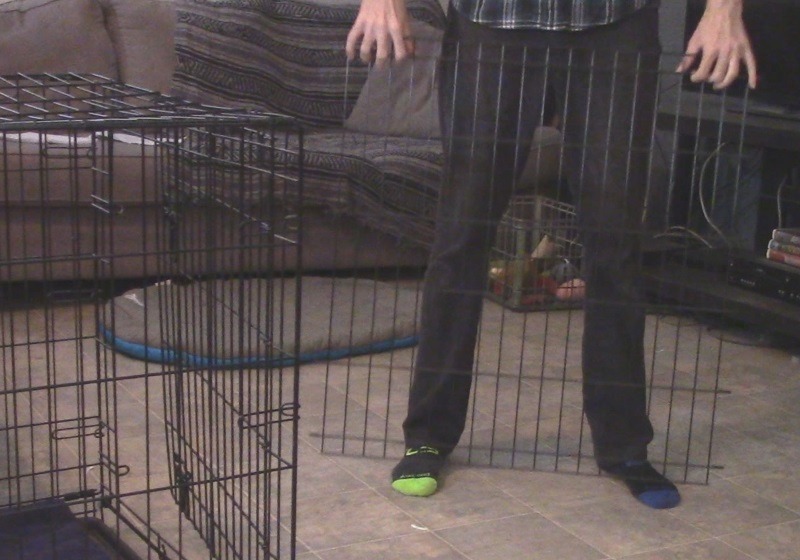
For house trained adult dogs who need the crate for behavior management:
The above size recommendation is the minimum, but there’s no upper limit. You can get one as big as your heart desires – and your home and budget can accommodate. I’m sure Sparky would appreciate the extra leg room.
Where should you put the crate?
Keep it in an area that gets a decent amount of household activity so your pup can feel like he’s part of things.
Pro tip: for puppies and rescue dogs who still cry when left alone, put the crate in the area of your home where people spend the most time. Like the living room. That way, you can easily practice duration without adding the extra challenge of distance.
And hey, there’s no rule that says the crate must be kept in one spot only. Lots of people find it helpful to put the crate next to their bed at night, and in the main living area during the day.
Make it comfortable: Place an old blanket or towels inside. I wouldn’t spend money on any fancy adorable dog bedding for a puppy. It will get chewed up and/or peed on.
To wrap this up: Crates aren’t 100% good or 100% bad. Used thoughtfully, they can make your life much easier. Used poorly, they just stress everyone out. Listen to your dog, and make the decision that works best for the two of you.
See also:
- The Insider’s Guide to Adopting a Shelter Dog: From Mental Prep to Picking the Right Dog for You
- After you Adopt a Shelter Dog: What to Expect, What to Do, and Mistakes to Avoid
- We Talked to Thousands of People Who Returned Their Dogs. Here’s What They Wish They’d Known
- 25 Ways to Get Your New Dog to Trust, Love, and Respect You